If you’ve been writing for any length of time, you’ll know from the advice of more seasoned writers that editing is an essential step in making your work shine.
All writers know in their heads that editing is necessary, but often our hearts rebel. We frequently love the writing process—expressing ourselves on the page and writing beautiful things—but the editing process may leave us feeling less than enthralled.

But if you feel this way too, then I’ve got you covered! Let’s talk about editing and discover 14 tips for editing that will take the revision process from dreaded to delightful.
Why Should We Edit?
“Our standards for writing are higher and more formal than for speaking…We have only the words. They must be clear.” – Ursula K. Le Guin, Steering the Craft
Why is editing important? The heart of the matter, as Le Guin writes, is that with writing we only have the words on the page. We can’t hear the writer’s tone of voice when the words are said, we can’t see her gestures or facial expressions…there are only words to communicate everything that you would normal use sounds and movements to help express.
Anyone who’s spent time trying to decode a text message or figure out whether an emoji was sarcastic or serious will know the limitations of the written word. And the confusion only continues to grow when we write longer stories for blogs, email communications, books, or any other format. So we must be very careful in what we choose to say to make our messages clear.
Good editing takes a mediocre piece of writing and can transform it into something stunning. Something that will look more attractive to readers (or to potential buyers if you are in the content creation business).
Yet a surprising number of writers underestimate the value of editing, or simply feel confused or disheartened by it.
But never fear, editing doesn’t have to be hard! Let’s take a look at some easy general editing tips, as well as specific editing tips for structure and mechanics, that will help you transform your writing today!

General Editing Tips
1. Take a Break
This is the easiest of all the tips—simply set your writing aside for a while. Why? Well, when we’ve just written something, we’re far too close to it to see it clearly.
Think of yourself like a parent. A parent of an ugly baby. Do parents of ugly babies ever think their babies are ugly? NO! Because they’re too close to them. It’s their creation, so of course THEY think it’s beautiful. But everyone else around that can see it’s not cute AT ALL.
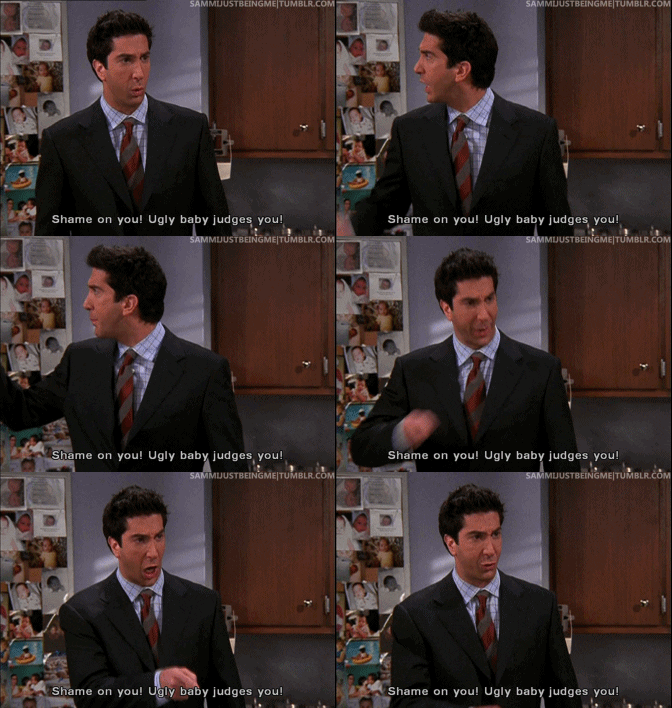
Your writing is your baby. Is it cute? Maybe, maybe not. Can we improve it? Of course! So set it aside for a while (a couple hours, a day, a week) so you can get some emotional distance from your writing. Then you’ll be ready to examine and edit it with fresh eyes!
2. Read Your Writing Aloud
If you’ve ever had the pleasure of hearing writers talk about editing, then you’ve almost certainly heard the common refrain: Read aloud! Read aloud!
Why does everyone recommend reading aloud? Because reading aloud helps you to hear your writing in a new way. And when you hear it in a new way, you’re more likely to notice errors that you might not have noticed when reading it in your head.
You may hear structural issues that you need to reorder, errors in sentences, lack of transitions, grammatical mistakes…the whole gamut. Awkward sentence constructions are especially easy to hear when you read aloud, but no matter what issues your writing has you’re sure to catch something you wouldn’t have caught otherwise.
Let me warn you, though: you’ll feel like an idiot reading aloud. But it will be worth it!
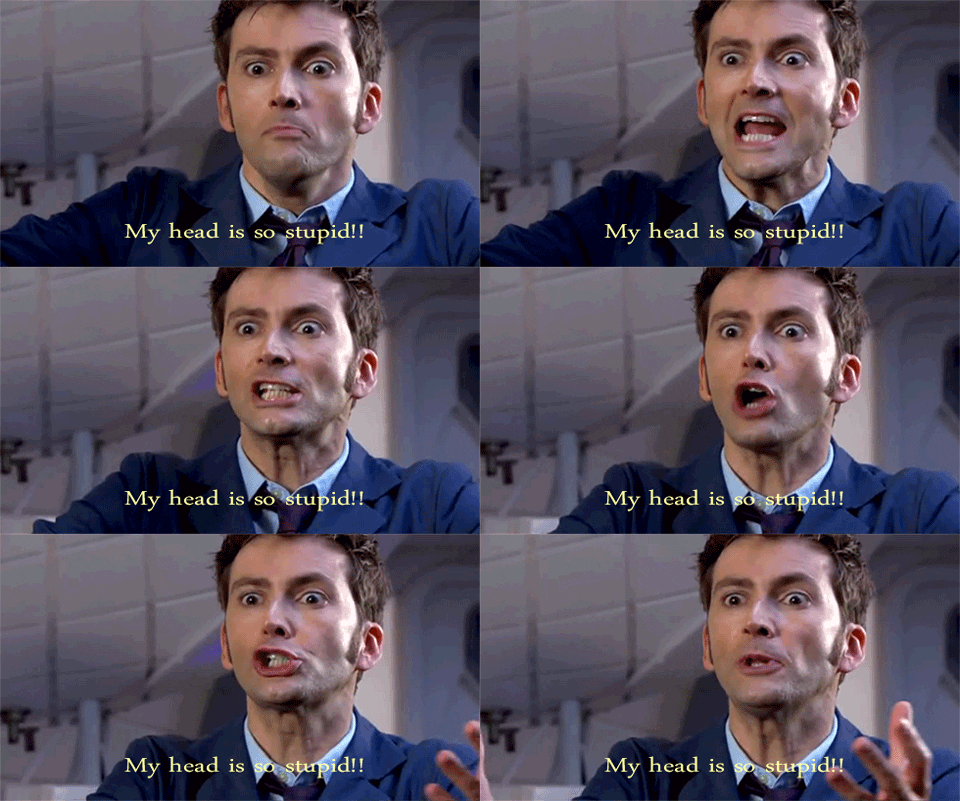
Tip: Here are some ways to feel less stupid when reading aloud: 1. Find a private place away from everyone. 2. Pretend you’re in Monty Python sketch. 3. Make someone else read your writing aloud to you.
3. Print it Out
Writing on the computer is wonderful…especially since it is so easy to reorganize and make changes. But if you really want to edit carefully and make sure your writing is perfect, print it out! Having your writing in a physical form in front of you helps you be more careful as you read, and makes you less likely to accidentally skip over small or big issues.
In addition, when you have it printed out you can try my favorite editing trick: grab a pencil or pen and drag it along above each line as you read. If your pencil stops or hesitates in a spot, you’ll know it when you look back at the lines you’ve drawn.
These hesitant areas are places where your brain may have subconsciously noticed something was wrong even if you didn’t consciously notice it. So now you can go back and reread those sections to figure out what you need to fix!

Structural Editing Tips
One of the keys of good editing is to edit in stages. The first editing stage should be reading for structure—just like the first step in building a building is making sure you have the structure in place. So forget about grammar and issues of mechanics for now, and simply focus on the big picture of your writing. Here are some tips to help with this stage!
1. Check for Organization
Organization is one of the biggest structural issues, so this is a good place to start in your first round of editing.
You’ll want to check your introduction and conclusion to make sure they’re in place and that they hook the reader and sum up your story respectively. But next, and perhaps more importantly, you will want to make sure that all the content in between these bookend paragraphs flows logically.
To do this, I recommend writing a sentence in the margin for each paragraph. This sentence should tell what each paragraph does for your story so you can see how it contributes to the story as a whole.
Then, when you read back over the notes you’ve left, check to see if all the paragraphs contribute in some way or if any seem like unnecessary tangents. If anything is unnecessary, remove it.
Next, check to see if any paragraphs are in the wrong place in the essay. You want to make sure that your writing flows logically instead of skipping around to different ideas without rhyme or reason. If a paragraph is in the wrong place, then move it!
Finally, check to see if you have several paragraphs talking about one idea. If you do, you may not need all of them. So think about combining two or more of these paragraphs together. It may not always be necessary to combine, but we want to make sure each paragraph has a function and functions well…so consider this carefully.
2. Control Your Pace
Checking the organization on a paragraph level should have ironed out some big issues in your writing, but now it’s time to look at pace. Does your writing flow at a good speed? Or are you too bogged down in details in some sections? Do you skim over important information in other places?
Pacing is a way to control the rhythm and the speed at which you pull your readers through the events in your writing. Sometimes you’ll want the pace to be even, sometimes you’ll want it to go faster (for instance, if there’s an exciting event happening and you want your reader to experience that sense of movement).
So think about your intent in each section and ask yourself if its current speed contributes to the feeling you want to express. If it doesn’t, think about how you can speed it up or slow it down.
3. Remove Repetition

Do the ideas in your writing repeat themselves over and over again as you try to explain your point? Is your writing starting to feel like Groundhog Day? Time to fix that!
Part of clarity in writing means you should say exactly what you mean…and then move on! Don’t keep circling around to the same point again and again or keep returning to it later in your writing.
Check to see that each paragraph has one topic and that you stay on topic. Say all that you have to say, and then allow your writing to progress to new ideas.
4. Cut Anything that Doesn’t Work
This is the hardest (and saddest) part of editing for many writers: cutting out all the unnecessary parts.
It’s especially sad when the unnecessary parts are some of your favorite and most beautiful writing.
Hopefully with the organization stage (step 1) you already tossed out any unnecessary sections on the paragraph level, but now it’s time to go through on a sentence-by-sentence basis to make sure every piece is contributing to making your writing a success.
Why is this necessary to do in the editing stage instead of just when you’re writing? As Jon Franklin says in Writing for Story, “The simple (or not so simple) process of writing the story through, if you’ve invested yourself in it, has changed you. You’re no longer the same person.” When you’ve made it to the end of writing the story, you can now see your story from the inside, whereas before you could only see it from the outside. And with your insider’s view you will understand more of what the story needs and how you need to tell it.
And sometimes this will mean cutting out your favorite parts, because from an insider’s view you can now see that they’re just clutter. Beautiful clutter. But still clutter.
So let’s cut and throw away without remorse! Our readers don’t want confusion, they want clarity. So let’s do our best to give them clarity.

Grammar and Mechanics Editing Tips
Once you’ve completed the structural stage of editing, it’s time for round two: editing for mechanics. This stage focuses on the small and specific, looking at grammar, spelling, and other choices that affect how you say what you’re trying to say. Let’s dive in!
1. Check Your Spelling
This one should be obvious (hopefully!) and thankfully we have spellcheck today to make our lives easier. But you still have to be careful…especially with words that are homonyms like “our” and “are” or “two” “to” and “too.” Spellcheck won’t always catch these mistakes for you! So take a quick moment to make sure your spelling and word choices are correct.
2. Police your Punctuation
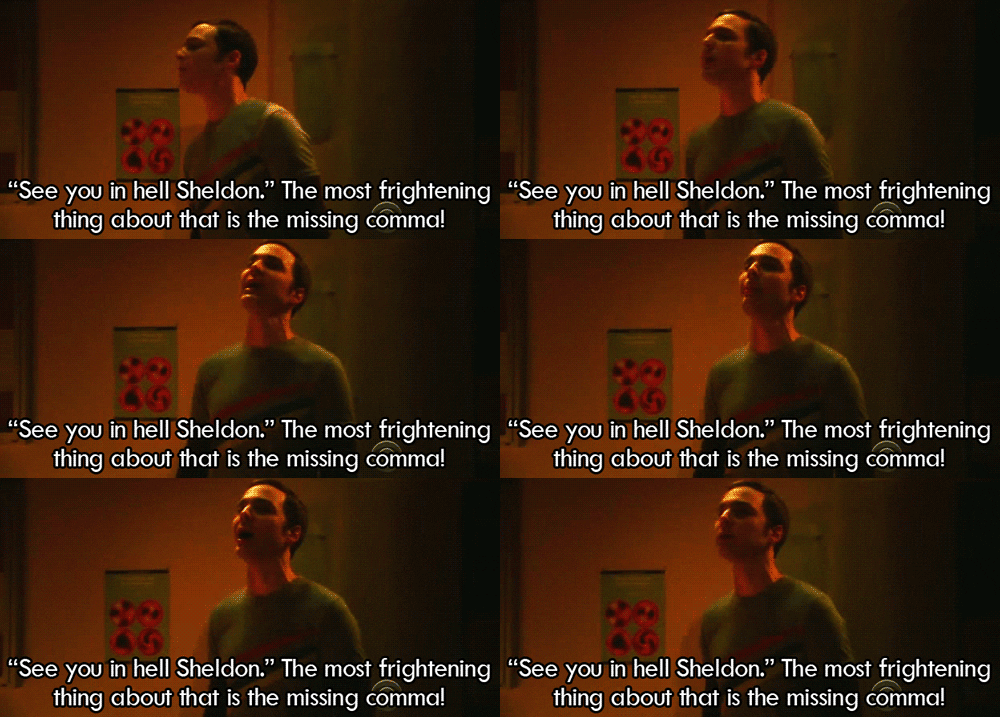
Do you know when to use a comma? When to use a dash? When to use a colon or semicolon? If you don’t (or if it’s all a little fuzzy), now’s a great time to pick up a punctuation guide like The Elements of Style or Eats, Shoots & Leaves.
When you edit you’ll want to watch out for places where you use too much punctuation. It can be especially easy to overuse and misuse commas, which can affect the flow for your readers. So grab a style guide and start cutting out unnecessary punctuation!
3. Remove Redundant Words
Now that we’ve removed unnecessary punctuation, it’s time to remove redundant words. This will help make your writing more concise and clear.
Like redundancies in your ideas, occasionally you’ll find yourself with redundant words in your writing. Words like “exact same,” “close proximity,” “combine together”…each of the words in the pairs have the same meaning, so you do not need them both in your sentence (unless you’re trying to hit a word count for a paper you have to turn in 😉) Using these duplicate words just makes your writing wordy.
Removing redundant words also applies to cutting unnecessary word phrases like “in order to” or “be able to.” If you’re going to write a story in order to share your ideas with the world, you’re really just writing a story to share your ideas with the world. If you are able to write a story, you can write a story.
So in this step, try to make your sentences more concise whenever and wherever you can!
4. Vary Sentence Lengths
Journalism and the blogging world tries to tell us that the only good sentences are short sentences (I’m with Ursula K. Le Guin in responding that this is only “true for convicted criminals”).
I firmly believe you should vary your sentence lengths, as this will make your writing more pleasing to read. Too many short sentences sounds choppy, too many long sentences sounds long-winded and wordy.
Of course, any long sentences you write should still be easy to read. They should not be convoluted and long just for the sake of being long. But similarly, your short sentences shouldn’t be short just for the sake of being short.
So as you edit, try for some variation! Think about the rhythm of your writing. Do you gravitate toward short sentences? Do you rely on long sentences? Then try to switch it up so you have some of each.
Tip: Keep in mind what each sentence is trying to do. As a general rule, short sentences often correspond with action and long sentences often correspond with places where you are building emotion.
5. Pass on the Passive Voice
Passive voice isn’t wrong, but using it can make it harder to understand your writing. So use it judiciously.
What is the difference between active and passive voice?
Active voice: She writes the story.
Passive voice: The story was written by her.
So what’s the difference? In active voice, the thing doing the action is the subject (she). In passive voice, the thing receiving the action is the subject (the story).
We often use passive voice to hide who did the action (like when you were a kid and didn’t want to admit who did the bad thing your parents are going to be upset about…”The cookies were eaten.” “The window was broken”).
But besides cases of hiding blame, passive voice is unnecessary most of the time. You’re free to use it, but just be aware of when, where, and how much you use the passive voice so you don’t accidentally hide your message behind a wall of confusion.
6. Eliminate Static Verbs
As mentioned earlier, writing’s biggest limitation is only having words on a page to express your meaning. This limitation means that writing can easily become static and boring if you don’t watch carefully!
But you can counteract this tendency towards the static and boring by being picky about the verbs you choose.
Action is the name of the game here; try to avoid versions of the verb “to be” (“is,” “am,” “are, “was,” “were,” “being,” “been”) as well as verbs like “have,” “has,” “had” and “do,” “does,” “did.”
The above are all static verbs, and especially in storytelling you want to remove these from your vocabulary as far as possible.
Instead, replace them with stronger and more active verbs. For example:
Static verb: They were confident again.
Active verb: They regained confidence.
Using verbs with action rather than using static verbs will make your writing more powerful, concise, and snappy…so it is worth the time to go through your writing with a red pen (or the CTRL+F function) to activate those verbs!
7. Watch Your Adverbs and Adjectives
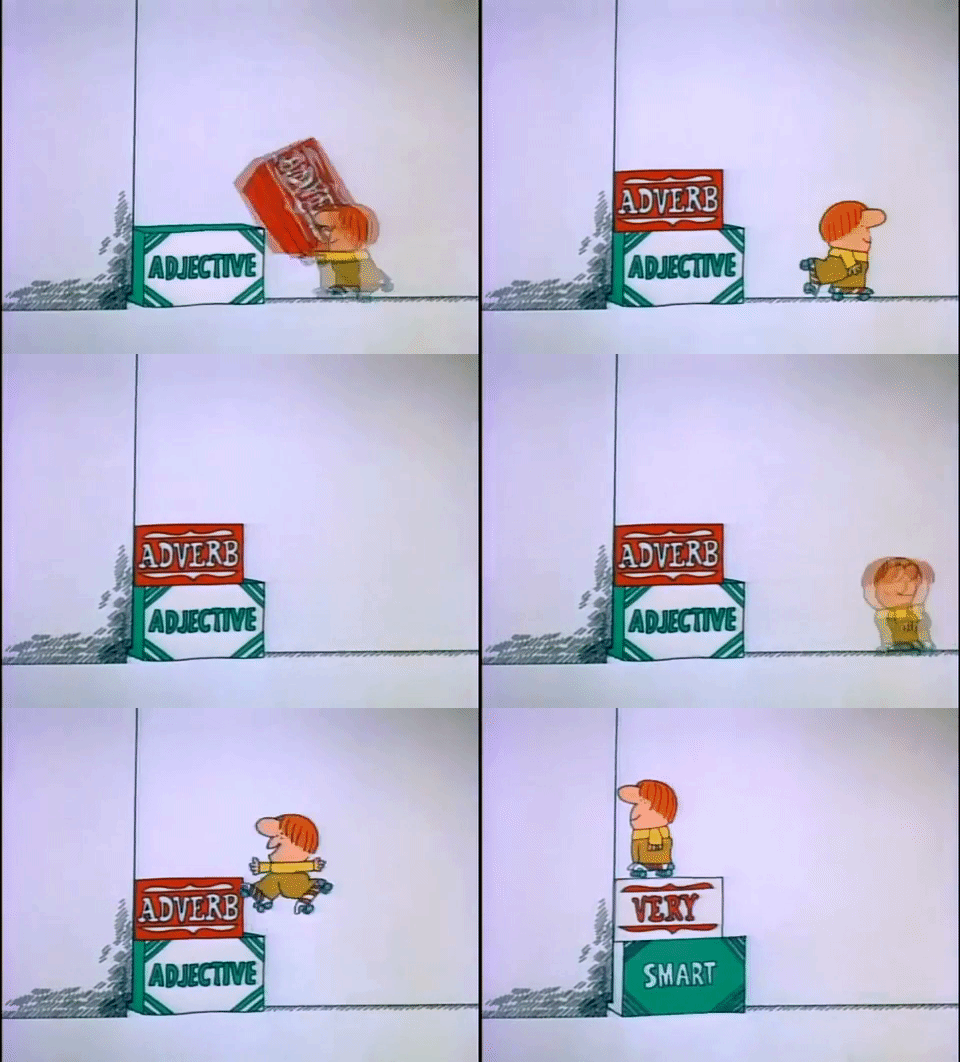
Sometimes adverbs and adjectives help you describe, but often they are unnecessary or unhelpful. As you edit you will want to determine where you can replace or update your adverbs and adjectives to make your writing more descriptive.
For example, does the person you’re describing walk slowly…or do they amble? Does the front door close loudly…or does it slam? Instead of using the adverbs “slowly,” “loudly,” etc., try removing the adverb and replacing the verb with one filled with more meaning.
Similarly, adverbs like “very,” “just,” or “really” can make your writing more wordy than it should be. Which is better: she was very happy…or, she was ecstatic? He was really tired…or, he was exhausted?
Replacing the verb + adverb combination with a more powerful verb, and replacing the adverb + adjective combination with a more powerful adjective will make your writing far more compelling.
Anything to add? What are your best editing tips and tricks? Share in the comments below!
Save for Later

This post may contain affiliate links. Check out my disclaimers to learn more.
Leave a Reply