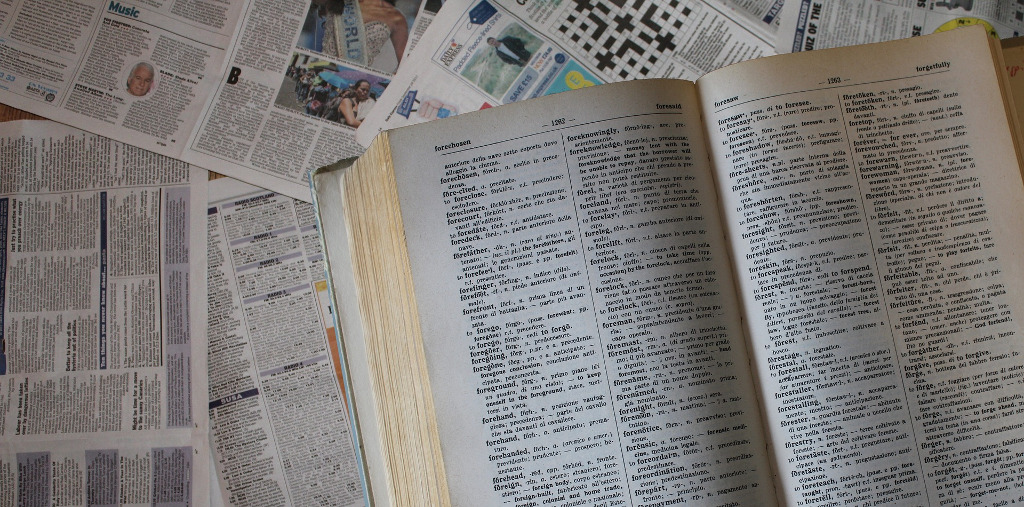

“Any suggestions for a word we should look up in the thesaurus?” I asked, marker in hand as I turned to look at my English as a Second Language (ESL) class.
All six adults, from varied places like India, Colombia, and Taiwan, stared back at me in silence as they tried to think of an example. At least, I hoped their blank looks indicated that they were thinking of an example…and not just tuning me out as they dreamed about what they would do after class.
Today was our first day using a thesaurus for English synonyms, and I was hoping they would discover whether this tool could be useful for them.
All of a sudden, a voice called out with quick decision: “Discombobulated!”
Now I have to admit, “discombobulated” is not a word you usually expect to hear when you’re working with a group of intermediate English learners. But I also have to admit it’s a fun word to say and catchy to remember.
“Oh, very nice!” I responded. “‘Discombobulated’ means to be confused. And a little uncertain. Now, when you search for ‘discombobulated,’ what synonyms do you find?”
My students started searching, and were soon giving me responses like: Perplexed. Confounded. Flustered. Muddled. Bewildered. Puzzled.
All perfectly normal and expected synonyms.
But pause for a moment: if you were teaching English language learners, would you tell them that “discombobulated” equals “muddled” or “flustered” or any of the others above?
Do these words really mean the same thing? And if not, are they really synonyms?
Do synonyms even really exist?
English Language Synonyms: Do Synonyms Exist?
Jon Franklin, in his book Writing for Story: Craft Secrets of Dramatic Nonfiction, posits the idea that synonyms do not exist. He writes that Roget’s International Thesaurus is founded on an “erroneous principle—the principle that there is such a thing as a ‘synonym.’”
Franklin then goes even further and exclaims that “Roget’s perception that [words] have any useful degree of interchangeability represents a total misunderstanding of what the language is about.”
To some degree, I agree with Franklin’s assessment. If we think of synonyms like a mathematical principle of “a” = “b” or “discombobulated” = “flustered,” then I would have to say that I don’t think synonyms really exist.
After all, what is the point of having multiple words if they mean the exact same thing? What happens to the precise and sophisticated subtleties of language if words become completely interchangeable?
But if “synonym” means something else…well, then, that’s the question. What does synonym really mean? And can synonyms be useful?
What is a Synonym?
According to the dictionary, the meaning of synonym is “A word or phrase that means exactly or nearly the same as another word or phrase.” Of course, the term synonym only applies when you are talking about two words within the same language that mean the same thing.
So “shut” and “close” are synonyms, as are “laugh” and “giggle.”
Although the definition does clearly state the idea of an “exact match” between words, I want to focus on the second part of the definition: “nearly the same.”
I would argue that the majority of synonyms (if not all) fall into this second definition. A laugh and a giggle are in the same category of idea, but we all know that a laugh is different from a giggle.
And while “shut” and “close” seem very similar, think about when you would use each one, who you would say it to, and why. Beyond the idea that you can’t shut some things you would close (a case, for example), would you be more likely to use shut in an informal situation and close in a more formal one?
Perhaps, perhaps not. But it’s in thinking about these issues that you find that even the most nearly exact synonyms have some range of usage considerations that render them not an exact synonym—but a near synonym.
Shades of Meaning: The Usefulness of Synonyms
So, if there’s no such thing as an exact synonym, how can synonyms be useful?
Think back again to my ESL students and their synonyms for “discombobulated.” Perplexed. Confounded. Flustered. Muddled. Bewildered. Puzzled.
If you asked a native or fluent English speakers if these words all mean the same thing, they might at first say yes…but that yes would turn quickly into a no, just like our examples with laugh and giggle and shut and close.
“Discombobulated” means confused and a bit uncertain, whereas “flustered” means confused and agitated or even a little embarrassed. “Muddled,” meanwhile, contains an idea of blank confusion, with perhaps just a tinge of sluggishness.
Clearly, these words do not all mean the same thing. And that is the beauty of a thesaurus and of synonyms—THEY DON’T MEAN THE SAME THING. Each one has its own shade of meaning that sets it apart from the others.
This means you can change one word and in doing so you can change the meaning of the entire sentence.
If you’re a native English speaker, then you’re in luck as it’s likely you can already recognize the emotions and feelings tied into many synonyms. You may not always be able to express it, but experience has taught you about the shades of meaning for different words.
If you aren’t a native English speaker, then some of these synonyms’ shades of meaning may be more difficult to understand. Using a dictionary can be helpful, but it may be even more helpful to ask a native English speaking friend to model the different words for you…or ask them in which situations they would use each synonym.
Why is this so important? Well, in your writing and storytelling, choosing the right word is paramount. It is everything.
The Power of Using a Thesaurus

Okay, so we decided Franklin was at least partly right about the non-existence of synonyms. The heart of what he was trying to say is that you have to choose the right word for the right place. And usually, there is only ONE right word. But does this mean we shouldn’t ever use a thesaurus?
On the contrary, this is where sometimes a thesaurus becomes invaluable in our writing. A thesaurus, after all, is a list of words all within the same category, conveniently compiled for our browsing.
Say, for example, that you are writing about a character who is confused:
Lisa looked out the window, confused to see snow falling from the sky.
We understand what this means, but how does it change if we try a different synonym?
Lisa looked out the window, perplexed to see snow falling from the sky.
Or:
Lisa looked out the window, flustered to see snow falling from the sky.
Although all three of these are “synonyms,” the emotional meaning behind each is very different. The first is the most neutral—simply confused. The second one conjures up images of Lisa with her eyebrows furrowed as she puzzles about why the snow is falling. The third one—flustered—seems to imply that the snow falling makes her confused and perhaps a bit nervous for some reason.
Now let’s say that you are writing, and the only word you can think of is “confused.” (this happens to me more than I’d like to admit!)
You can only think of “confused,” but you know that there’s a better word choice. You know because you’ve heard this word before. But somehow it’s gone to that little void in the back of your brain, or accidentally been tossed out with the trash.
And you KNOW that the word you’re looking for is somehow related to “confused,” but it’s not just “confused” because there’s that empty little part near your heart that tells you you’re forgetting the right word.
This is when I use a thesaurus. Not when I want to sound more educated or grandiose by using big words. Not as a cop out or a thought of “eh, these all mean the same so just pick one.” No—a thesaurus is there as a memory aid when you have that little inexpressible feeling that there’s a right word out there but you just can’t quite remember it.
Listen to that little voice in your head; listen to that hollowness near your heart. Because there probably is a word. And it’s the right word. And you want it.
Because it’s important to choose the right word every time if you want your writing to make the greatest impact it can.
So next time you’re writing, don’t feel perplexed, puzzled, and too righteous in your belief that synonyms don’t exist—because they do. At least, near synonyms do. And they’ll help you find a way to express the shades of meaning that you know in your heart are just waiting to be revealed.
Do you believe synonyms exist? Do you use synonyms or a thesaurus in your writing? Sound off on this debate in the comments!
Save for Later

Leave a Reply