

Raise your hand if anyone’s ever told you to “focus on the big picture” 🙋♀️
This refrain usually comes from well-meaning friends at a time when our minds are scampering around like a squirrel and our anxiety kicks in and we probably need a massage because we’re just so stressed and CAN’T DECIDE WHAT ROUTE TO TAKE in our lives, or our writing, etc.

“Focus on the big picture” is also usually preceded by something like “don’t sweat the small stuff” or “you’ve got to move past the small things.” We’re told to focus on this magical big picture that’s going to be the key to our success and to forget about the smaller details that make us anxious.
And maybe this works for increasing our productivity. Maybe it really helps us see our goals more clearly and take actionable steps toward our future.
But when it comes to writing and sharing our travel stories, is this big-picture approach really the best method? Or does the secret lie in writing and thinking “small” to impact our readers in big ways?
The Big Picture About Big Picture Thinking
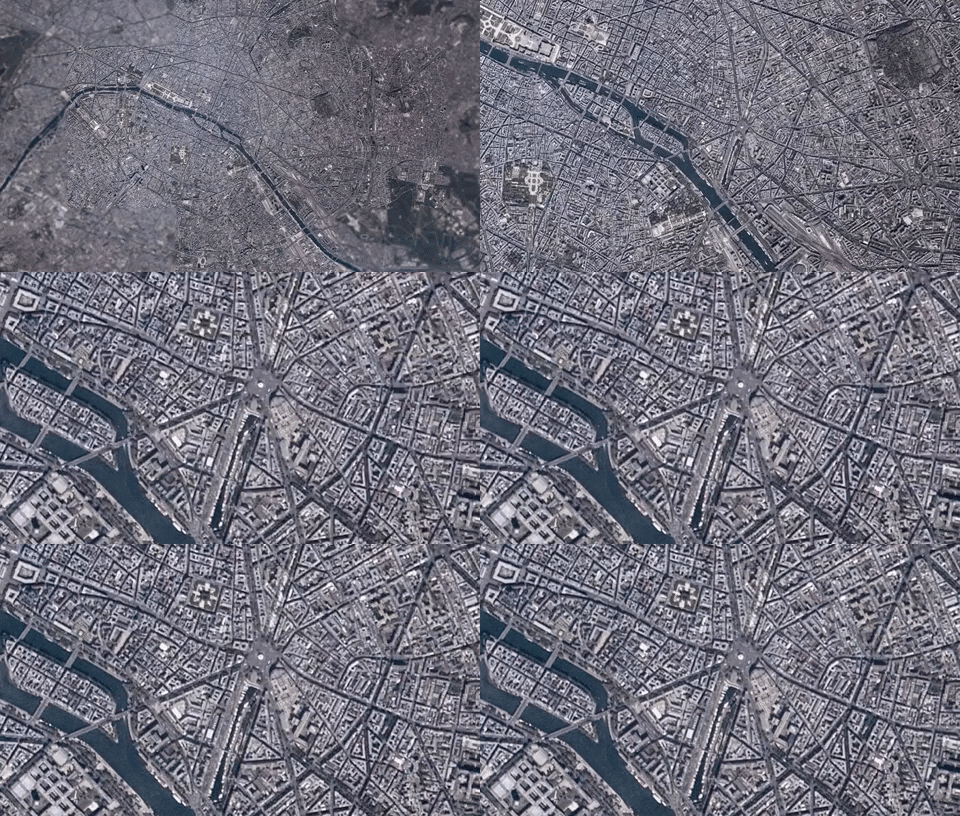
What is the big picture and how can it be useful?
Big pictures are literally just that—Big. Pictures. It just means that you can see the entire perspective on an issue or a situation (kind of like how seeing a whole map of Paris would give you a better idea of how to navigate the city).
Clearly, big pictures can be useful in certain situations. If you are trying to make big decisions, it can be helpful to understand all the central issues—and nearby issues—so you know what you should focus on and what decisions you should make.
However, big pictures by their nature force our brains to think analytically and in abstractions—in terms of ideas. And usually, these ideas are not very concrete, but instead exist mostly theoretically in our own heads.
For those trying to tell compelling narratives, big picture thinking is death.
The Storytelling Mindset
In contrast to big picture thinking, the storytelling mindset puts its readers and author into a mentality of thinking in terms of feelings and emotions.
The reader is forced to think small and specific—to think in concrete details and actual experiences.
To illustrate the concept of how a story impacts readers, think of one of the classic Aesop’s Fables: The Tortoise and the Hare.
In this story, does Aesop start out by telling us the big picture idea? Does he start out by telling us the core principle he wanted to convey, that “working slowly and steadily is better than acting quickly but carelessly” or that “natural ability is ruined by idleness”?
No, of course not! Instead, Aesop tells us the big picture through a story—a concrete, detailed, example-filled story with two clearly-defined characters with character flaws and strengths.
So have people remembered this story over the years? OF COURSE! This tale has endured at least from the times of Ancient Greece until today. It’s been adapted into books, movies, and has clearly transcended across culture and languages (it’s not just in Greek, after all!).
Now, do you think that this story would have gone so viral across the world and across time if Aesop had instead focused on “the big picture”? If he had merely told us his big idea in PowerPoint form? OF COURSE NOT!

And if he gave us his ideas in this straight idea form, would children across the world know and remember the principle that “working slowly and steadily is better than acting quickly but carelessly”? That’s a no again.
But because Aesop instead focused on something we think of as a small thing—telling a story—children and adults across the world not only know his message, but also remember it. Because they remember the story and the story tells them the message.
Changing the Big Picture with the Storytelling Mindset
As travel writers, and writers in general, we have to change our own mindsets before we can use stories in the powerful way Aesop does.
How often do we feel like it is trivial to write down a story we overheard or discovered during our travels? How often do we feel that it is trivial to share the emotions and feeling we experience in a new place? How often do we fall into the trap of making lists of attributes rather than describing?
In our own minds, we have a divide between what we consider to be “big picture ideas” and “small picture ideas.” Unfortunately, stories often fall into the latter category. Because how could they be important?
But the example of Aesop is just one illustration of the power of stories. No one would remember his moral or message in the way they do today if he hadn’t told it in story form. His message is powerful and necessary on its own, but not memorable, until he tells it to us with a story.
Even though our brains often seem to minimize the importance of story when we consciously think about it, unconsciously we are all swayed and enchanted by stories. We remember stories, not facts. Our readers remember stories.
So how could we possibly consider stories to be unimportant or part of the small picture?
Write Small and Have a Big Impact
So here’s your challenge: stop thinking about the ideas—the abstract, analytical aspects of your writing. Instead, focus on the story—on the part that gets you and your readers feeling emotionally.
Even though stories feel like the small picture at times and even though it feels so much easier to think analytically or to list XYZ reasons to visit a place, it is much more powerful and memorable to describe with a story.
Because as it turns out, storytelling isn’t such a “small picture idea” after all. It’s just a big picture idea that was hidden away—and if you write using the storytelling mindset, you will actually make a big impact!
Save for Later


Leave a Reply